
What is the Duckworth-Lewis-Stern Method?
- The Duckworth–Lewis–Stern method (DLS) is a mathematical formulation designed to calculate the target score for the team batting second in a limited overs cricket match interrupted by weather or other circumstances.
- It is generally accepted to be the most accurate method of setting a target score.
- When overs are lost, setting an adjusted target for the team batting second is not as simple as reducing the run target proportionally to the loss in overs, because a team with ten wickets in hand and 25 overs to bat can play more aggressively than if they had ten wickets and a full 50 overs, for example, and can consequently achieve a higher run rate.
- The DLS method is an attempt to set a statistically fair target for the second team's innings, which is the same difficulty as the original target. The basic principle is that each team in a limited-overs match has two resources available with which to score runs (overs to play and wickets remaining), and the target is adjusted proportionally to the change in the combination of these two resources.
- The up-to-date Duckworth-Lewis-Stern method available on the app is commonly referred to as version 4.0. The app also still has the previous Duckworth-Lewis (Standard) version available as well.
What is the difference between Par Score and Target Score?
- Par score is the total that a chasing team should have surpassed - when they are 'X' wickets down - at the time of an interruption while target score is the revised score that a team is required to get after an interruption. If a chasing team is equal to the Par score, then at that point of the match, the scores are tied.
Keeping in mind that the local playing conditions for the competition should dictate how many overs need to be completed in the 2nd innings for a result to be achieved. - In a nutshell, par scores are calculated before an interruption, while targets are calculated after an interruption. The target is one fixed number, while the par score changes according to the number of wickets lost.
Example: Australia v India – 1st ODI in India in September 2017.
- In the 1st innings, India scored 7/281 in 50 overs.
- During the innings break, rain interrupts play, and the match is reduced to 21 overs.
- The 2nd innings commences, with Australia requiring 164 for victory.
- Australia finishes their innings on 9/137 off 21 overs.
- India win by 26 runs on D/L Method.
Calculating D/L While Live Scoring a Match
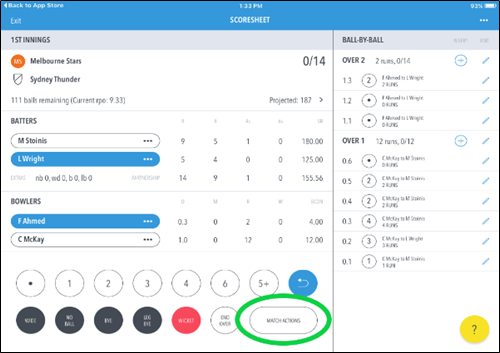
- To calculate D/L, the scorer can access this by;
1. Selecting Match Actions
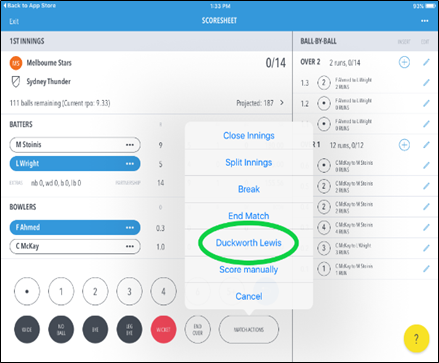
2. Select Duckworth Lewis
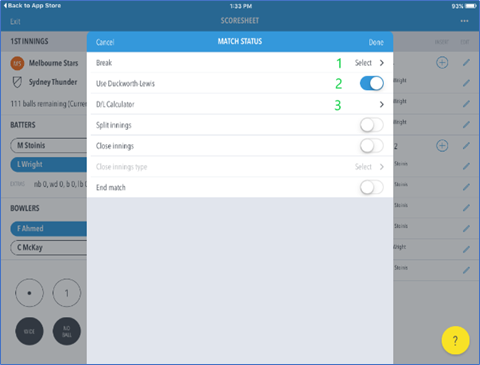
3. Select:
- The type of break (i.e. Rain Delay),
- Turn Duckworth Lewis calculator on and
- Then select D/L calculator (select from Duckworth-Lewis Standard or Duckworth-Lewis-Stern).
- When a suspension period has occurred (i.e. a Rain Delay), Select Suspension Periods
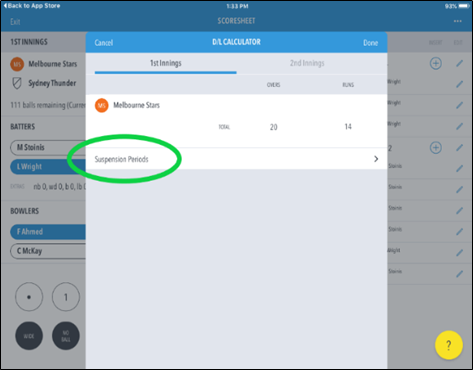
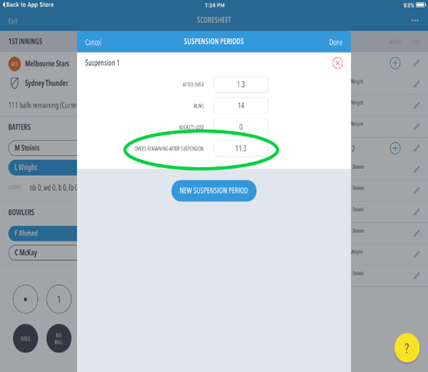
- Values for the first three columns should automatically filter (if you are Live Scoring). If they have, ensure that ‘Overs Remaining After Suspension’ value is correct.
As per the Example: if 1.3 overs have been bowled before play is interrupted and the match is reduced to 13 overs per side, 11.3 overs remain in the innings.
Once completed, click ‘Done’
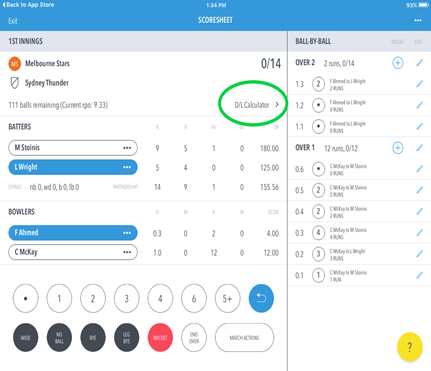
- Continue scoring once the match has commenced. Once D/L has been activated, scorers can then access the calculator (for any further breaks in play) in the summary score box.
- Continue scoring. If another delay in play occurs, follow Step 3.
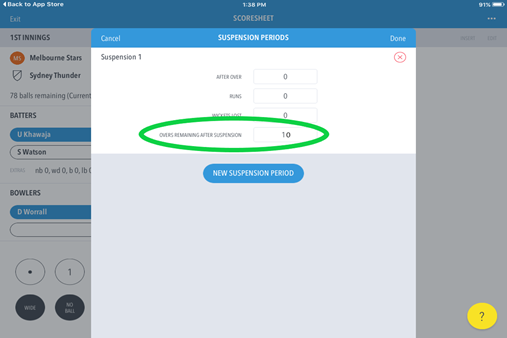
As per the Example: During the innings break, rain has interrupted play and the match is reduced to 10 overs per side. Use the D/L calculator to add in another suspension period and amend ‘Overs Remaining After Suspension’ to 10 overs.
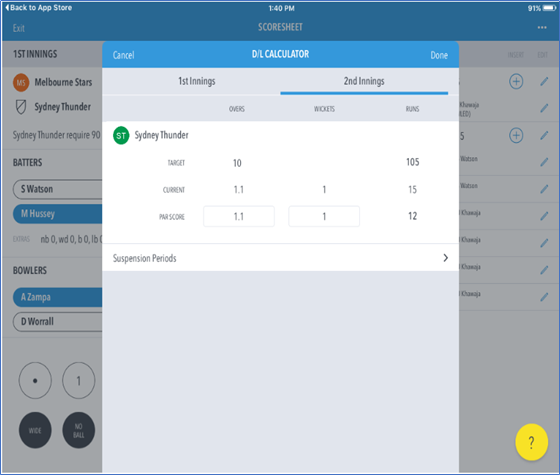
8. Target score are then automatically recalculated as per the adjusted suspension periods.

________________________________________________________________________________________________________________
The below recording shows (from start to finish) the Duckworth-Lewis-Stern method being applied in the 2nd innings of a limited overs fixture whilst scoring on a mobile device.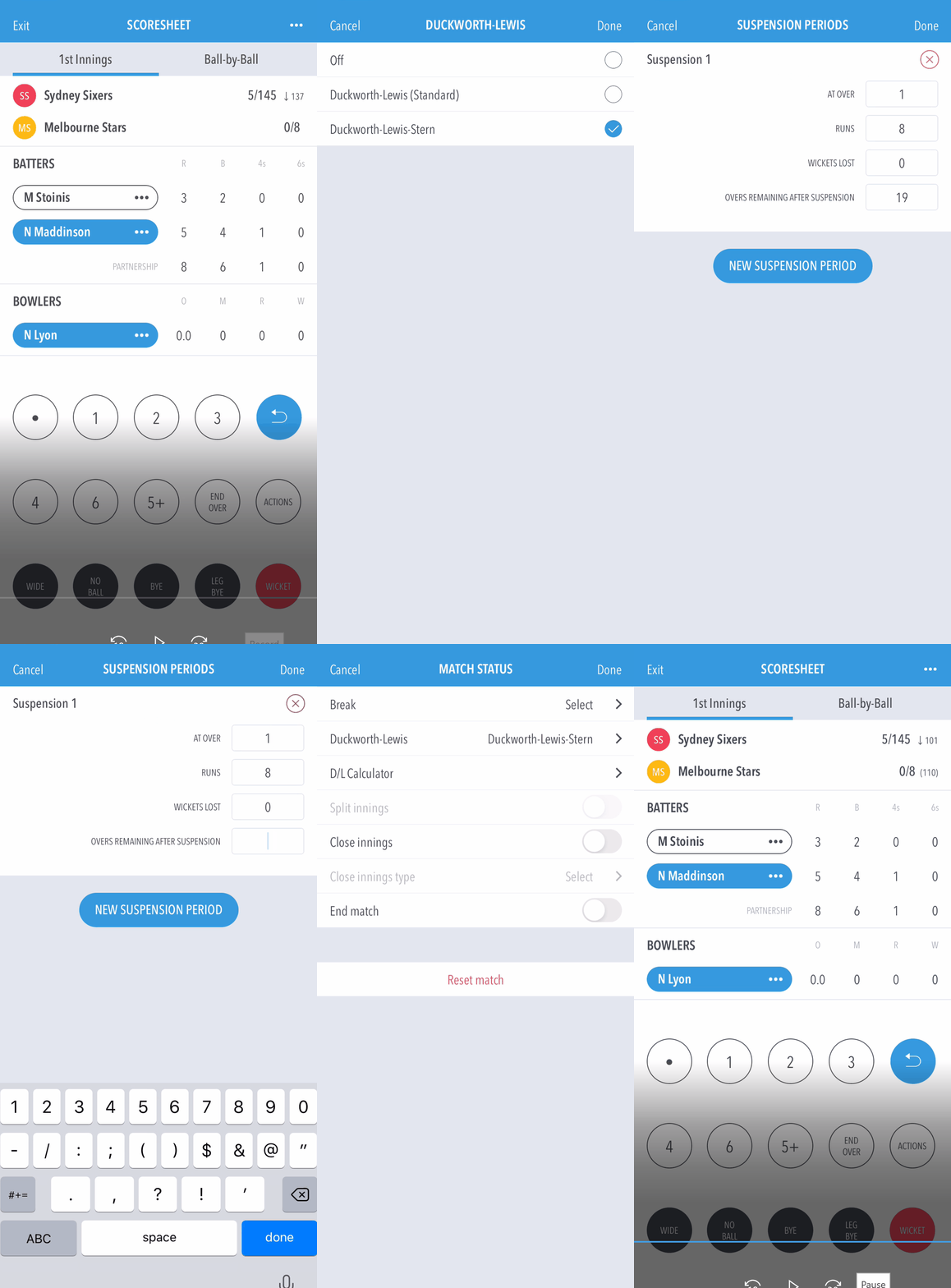
Comments
0 comments
Article is closed for comments.